
For decades, joint pain was often considered an inevitable tax on aging or a consequence of an active lifestyle. However, as we move through 2026, the landscape of joint health has been completely transformed. We are no longer in an era where the only answer to a “bad knee” is a massive, invasive operation and months of grueling recovery.
From ultra-precise robotic arms to “keyhole” procedures that allow you to walk the same day, the latest orthopedic surgery techniques are focusing on one thing: getting you back to your life faster and with more natural-feeling movement than ever before.
The Evolution of Precision: Advancements in Knee Replacement
Knee replacement surgery has come a long way since the early days of “one-size-fits-all” metal hinges. Today, the focus has shifted toward extreme personalization. No two knees are identical, and modern surgery finally reflects that reality.
3D Mapping and Digital Twins
One of the most significant advancements in knee replacement involves the use of advanced preoperative imaging. Surgeons now use CT scans and AI-driven software to create a “digital twin” of your knee joint. This allows them to simulate the entire surgery in a virtual environment before you even enter the operating room. By mapping out the exact bone structure and soft-tissue tension, surgeons can select the perfect implant size and alignment for your specific anatomy.
Muscle-Sparing Approaches
Traditional surgery often required cutting through the quadriceps muscle to reach the joint. Newer techniques, such as the subvastus approach, allow surgeons to work under the muscle instead of through it. By preserving muscle integrity, patients experience significantly less postoperative pain and a much faster return to basic activities like climbing stairs or getting in and out of a car.
The Robotic Revolution: A Higher Standard of Accuracy
If you had asked a patient ten years ago about a robot performing their surgery, they might have been skeptical. Today, robotic knee surgery is becoming a gold standard in top-tier orthopedic clinics.
It is important to clarify: the robot isn’t “thinking” for itself. Instead, it acts as a highly advanced GPS system for the surgeon. During a robotic knee surgery, the system provides real-time feedback, ensuring that bone cuts are accurate within a fraction of a millimeter.
Why Precision Matters
The longevity of a knee implant depends almost entirely on how well it is aligned. Even a slight tilt can lead to uneven wear and tear, eventually causing the implant to fail. The latest orthopedic surgery techniques utilizing robotics ensure:
- Sub-millimeter Accuracy: Implants are positioned to match the patient’s natural gait.
- Soft-Tissue Balancing: The robot helps the surgeon adjust the tension of ligaments, making the new knee feel “real” rather than mechanical.
- Reduced Trauma: Because the robot limits the surgical tools to a predefined “safe zone,” there is less accidental damage to surrounding healthy tissue.
Arthroscopy vs. Knee Replacement: Which Is Right for You?
One of the most common questions patients ask is whether they can “just get a scope” to fix their pain. Understanding the nuances of arthroscopy vs. knee replacement is key to managing expectations and achieving a successful outcome.
Knee Arthroscopy: The Minimalist Choice
Arthroscopy is a minimally invasive “keyhole” surgery. A surgeon makes two or three tiny incisions and inserts a camera (the arthroscope) to repair specific damage.
- Best For: Torn meniscus, ACL/PCL repairs, or removing loose fragments of bone/cartilage.
- The Goal: To preserve your natural joint for as long as possible.
- Recovery: Patients are usually back to light activity within a few weeks.
Knee Replacement: The Permanent Solution
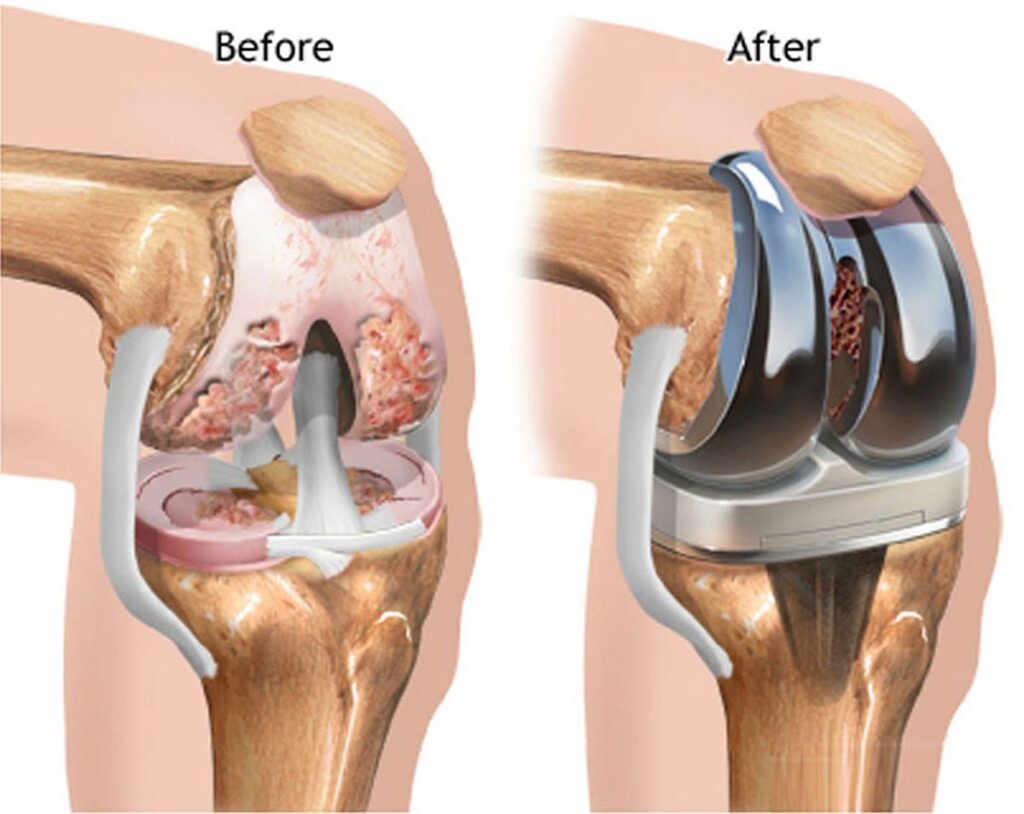
When the cartilage has worn down completely—the “bone-on-bone” stage—arthroscopy is often no longer effective. At this point, the mechanical structure of the joint has failed.
- Best For: Advanced osteoarthritis or rheumatoid arthritis where pain persists even at rest.
- The Goal: To replace the damaged surfaces with medical-grade metal and plastic.
- Recovery: While more intensive than a scope, advancements in knee replacement have shortened the primary recovery window to approximately 6 to 12 weeks.
In the debate of arthroscopy vs. knee replacement, the decision usually comes down to the “why” behind your pain. If the problem is a mechanical snag (like a tear), a scope is excellent. If the problem is a total breakdown of the joint surface, a replacement is the only way to find lasting relief.
Beyond the Operating Room: The “Smart” Future
The innovations don’t stop once the stitches are in. The next frontier in the latest orthopedic surgery techniques is the “Smart Joint.”
Wearable Tech and Smart Implants
We are now seeing the integration of sensors within knee implants and external wearable braces. These devices track your range of motion, step count, and even the “balance” of your stride during recovery. This data is sent directly to your surgeon’s office via an app, allowing for real-time adjustments to your physical therapy plan without you having to leave your house.
Regenerative Medicine
While not a replacement for surgery in advanced cases, biological treatments like Platelet-Rich Plasma (PRP) and stem cell therapy are being used alongside arthroscopy vs. knee replacement discussions to help speed up the body’s natural healing process.
Is Surgery Always the Answer?
Even with these incredible advancements in knee replacement, surgery is rarely the first step. Most orthopedic specialists will recommend a combination of:
- Targeted Physiotherapy: Strengthening the muscles around the joint to take the pressure off the bone.
- Weight Management: Reducing the load on the knee can significantly delay the need for intervention.
- Injections: Using hyaluronic acid or corticosteroids to manage inflammation.
However, if your world is shrinking because you can no longer walk the dog, play with your grandkids, or enjoy a vacation, it may be time to embrace the technology. Robotic knee surgery has turned what used to be a daunting procedure into a predictable, highly successful path back to an active life.
Final Thoughts
The goal of modern orthopedics isn’t just to stop the pain; it’s to restore your freedom. Whether you are a candidate for a quick “tune-up” through arthroscopy or require the high-tech precision of a robotic knee surgery, the options available today are safer, more accurate, and more effective than ever before.
If you are struggling with persistent joint pain, don’t wait for it to become debilitating. Consult with a specialist to see how the latest orthopedic surgery techniques can help you reclaim your mobility.